The syllabic form of Bridgian Phonetics is a development of the old grid-and-lines system, utilising individual, semi-phonemic glyphs rather than a continuous, unstructured anagon of sounds.
It was devised in early March 2025 – by the Devious One, as always – to combat major issues with the older form.
The main problem was that not all syllables could be expressed in one grid, because lines between points could not cross other points (and said points could not be repeated).
Punctuation was not supported; an expansion of the disyllabic lines scheme would have been impractical, especially with the old form’s strictly monospaced nature.
Syllabic-form Phonetics was designed to solve these issues, by fully separating phonic writing from the traditional Latin alphabet and English expectations.
In doing so, it reflects the true nature of phonetical writing: not as a alternative way of spelling words, but as a completely different medium of expression, unrelated to the grammar of language.
Structure
Hopefully this makes some sense…
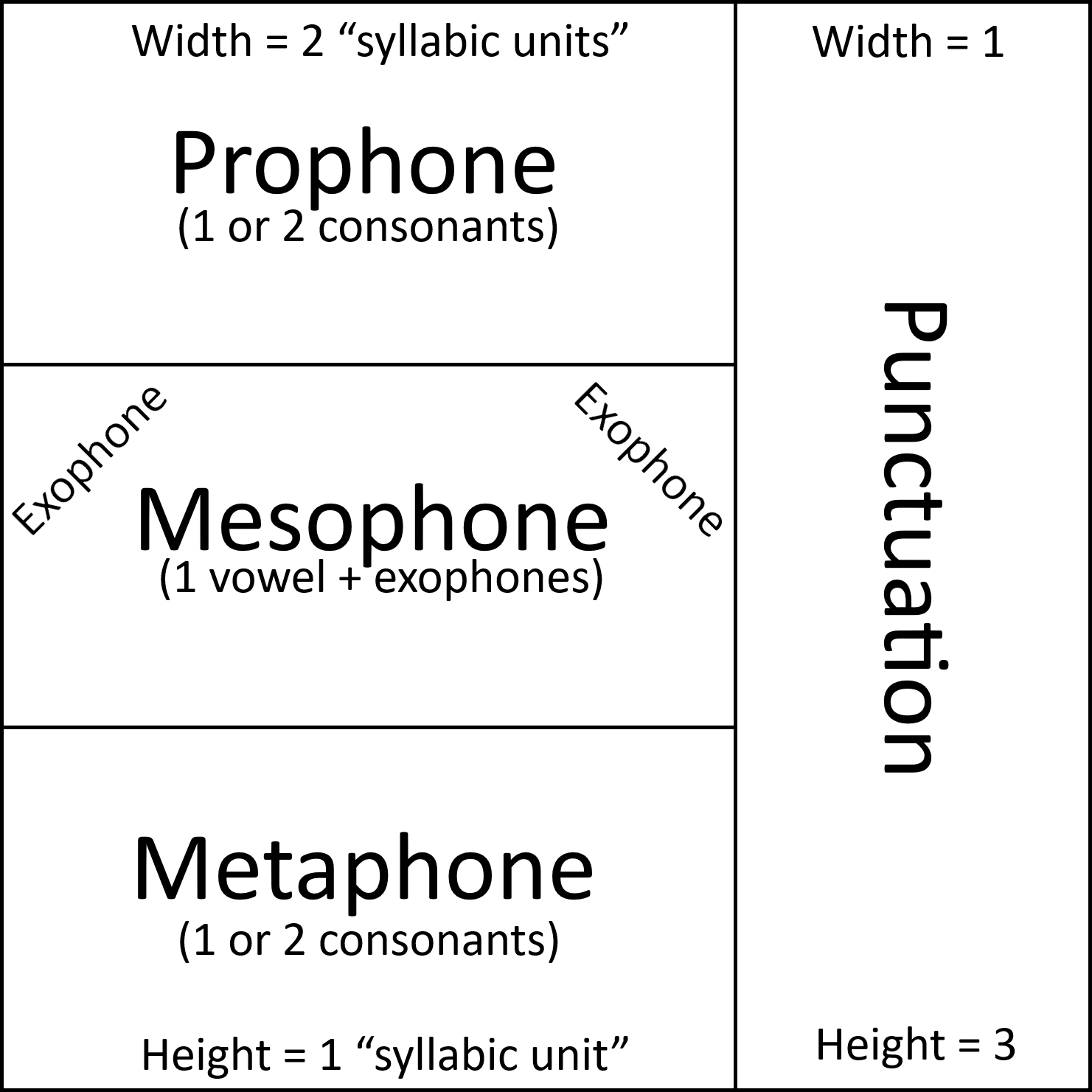
Each unit of syllabic form is made up of three glyphs in a vertical arrangement.
The top one – the “prophone” – represents one or two consonants, where left and right halves are joined together in the latter case.
The bottom one – the “metaphone” – works similarly, representing consonants after the vowel.
The vowel itself is known as the “mesophone”, and may have additional sounds (“exophones”) placed in the top-left and top-right corners.
This can be read from top to bottom, with first the prophone, then the left exophone, the mesophone, and the right exophone;
pronouncing finally the sounds represented by the metaphonic glyph.
Some of the sounds may be omitted (including the mesophone!), leaving empty spaces in their wake.
For more details on the glyphs used, see the syllabic symbols page.
Be warned, though – even more vaguely Greek-based terminology is unleashed here.
Maybe keep the image on the right within easy reach whilst reading.
Conversion
To convert a traditional-form text into syllabic form, first divide it up into syllables.
Consider, for each, the consonants before the vowel, those after it, and the vowel itself.
(Each of these may have no sounds present; however, if the mesophone is omitted, the metaphone must be too.)
Start with the vowel.
This forms the “base” (non-technical term) for the syllable, and may include up to two extra vowels with it: one on either side of the main mesophone.
Any instances of unaccented p, w, or y, except when forming the middle vowel, should be added as exophones.
However, if there are multiple “mesophonic” vowels – i.e., not p, w, or y – the syllable must be split in two.
Take the starting consonants up to the first mesophone as one, and the second mesophone and ending consonants as another.
Once the mesophone and exophone(s) have been determined, their respective glyphs should be placed in the middle of the syllable-representation.
These can, of course, be found in the syllabic alphabet table.
The other, consonant-using (technically, “symphonic”) glyphs are a little different from the meso/exophone.
They consist of either zero, one, or two sounds – but extras cannot just be placed like exophones.
If there is only one sound to represent, then conversion in the pro/metaphone is easy: simply take the symbol for the traditional letter, and put it in its appropriate place.
Diphonemic (two-sound) glyphs, however, are a little harder to represent.
They are done by taking a “left-half” form of the first sound, a “right-half” form of the second sound, and combining them together with a smooth curve.
This is made a lot easier with the Translator, but still doable when hand-writing.
Punctuation
The above steps are used for phonic syllables, but punctuation has a few additional rules.
Hyphens and affix-markers, firstly, have zero effective width, so they are placed directly between syllables – rather like the disyllabic lines of the older version.
They also have a “level”, which is indicated by the number of small horizontal lines either above or below the character.
Other punctuation is, ideally, half the width of a normal syllable, and have similar space-rules to those in English.
These occupy the full height of the line; to represent them, see the symbol-page’s punctuation table.