See anglicised version
Back to Bridgian language page
Bridgian syntax is very similar to English syntax in quite a few ways – e.g., verb-ordering, hyphenation, and some adjectives. The sentence “I will raid a Bridgian land per life-ending fight in this town” translates to þey ghey [sel] ral Bycbeys-so ghɐy hal enden-bheyga ımvɐyn ve þel beys – the words stay in the exact same order, emphasising this fact. However, there are a few differences:
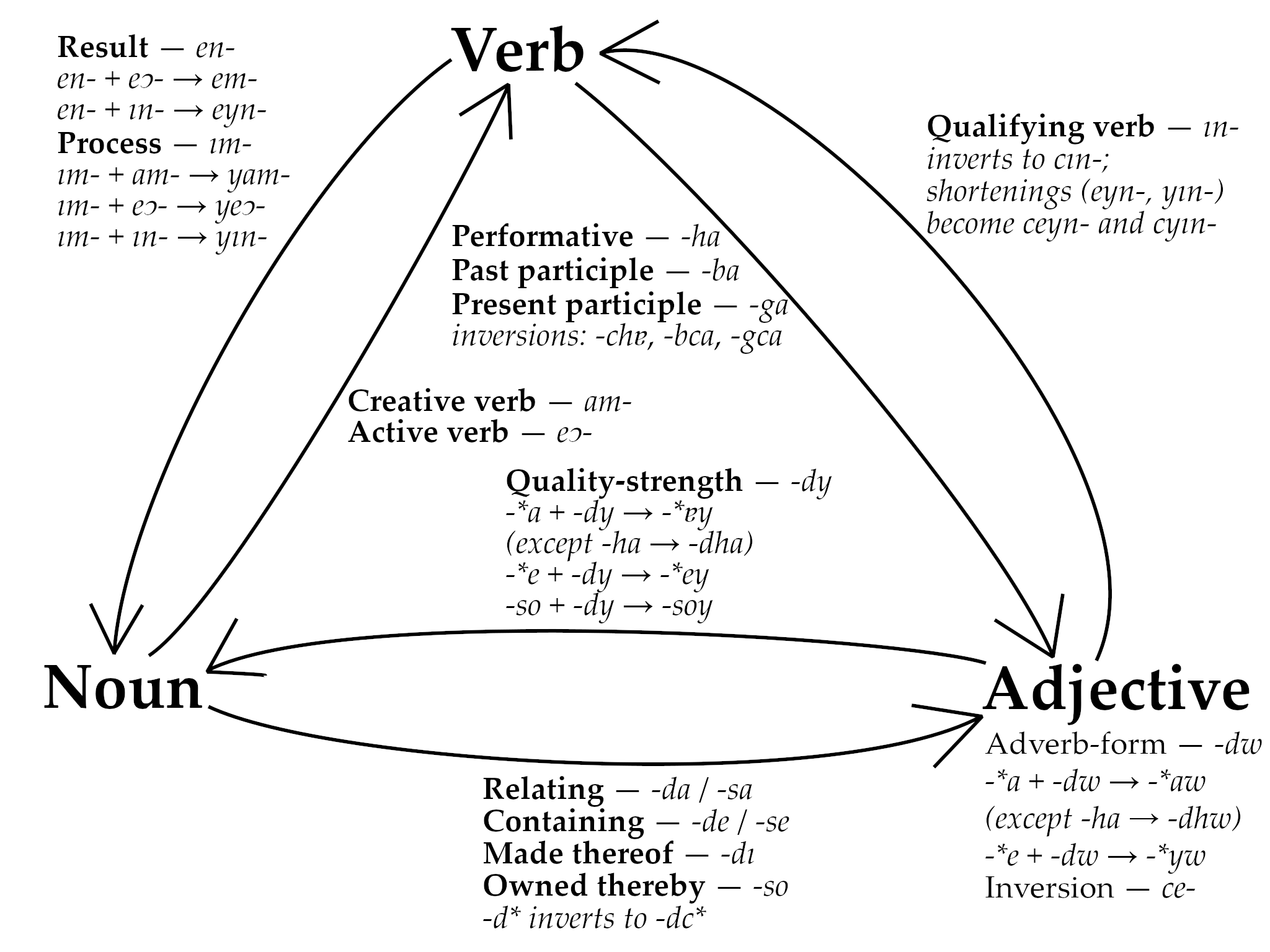
Bridgian words are made up of one or more root words, each connected to prefixes and suffixes. Each prefix or suffix can be connected to a type of word – adjective, noun, verb, et cetera – and will change its meaning, often altering the type of the word.
Content not loading? See the raw data-file here.
Hyphenation joins together root words and affixes to produce compound words, in a much simpler way than prepositions can. Hyphenation-syntax works similarly to in English, with the exception of commonly directly joining words together, something that takes decades to happen in English.
Each hyphenation in Bridgian is given a level, starting from 0, which determines the order for compound word–resolution. Specifically, hyphenations are resolved in the following order:
Below are listed the rules for hyphenation in Bridgian, where an the “level” of a word relates to highest level of hyphenation found within it, excluding outer affixes if applicable. Single-root words are considered to be level -1 in this system, except proper nouns, which are level 0 by default.
Hyphenation between affix and n-level root: level n + 2 if the affixion-order could be ambiguous, otherwise level n + 1.
Hyphenation between roots of levels m and n: level max(1, m, n + 1) if spread between words, else level max(m, n + 1)
The symbol used to denote hyphenation changes based on its level. In syllabic form, horizontal lines are put below (or above, in the case of prefixes) the hyphenation-glyph. In anglicised and traditional forms, notation is as follows:
Words in each pair are referred to as A-B, with the subject used for adjectives.
B is prescribed as a component of A, with B being the output noun. If B is a verb-result, -performer, or -process, then the output is the result, performer, or process, respectively, of the verb with A as the object.
B is described as a component of the subject; A prescribes a quality onto B. In English, examples would be ‘high-quality’ or ‘fast-moving’.
A being a participle, B applies onto the verb, with the subject as B's object.
If B is a past participle (i.e., ends with -ba), A is the performer of the verb unto the subject. Else, if B is a present participle or performative (i.e., ends with -ga or -ha), the subject is the performer of the verb unto A.
Words are stressed in Bridgian according to the following rules:
The Devious One, in his infinite wisdom, thought that people would understand Bridgian a lot better if he put lexical analysis to it. He was wrong, as evidenced below.
[element] – optional element(elements) – list of elementselement := ... – definition of an elementelement(T) or element(A, B) – subtypes of the elementelement(n) – numerical value for the element (hyphenation-level)T – a placeholder for any typewhere T ϵ {...} – limits on placeholder (one of the types in curly brackets)A+B – two elements joined together, no separationA + B – two elements joined together, separated by a spacem + n – numerical additionm − n – numerical subtraction (unspaced hyphens are part of names)<n – any value less than n; ≤n, >n, and ≥n work likewiseA+n – convert n to decimal and add to text‘...’ – a piece of textA | B – a “or” b (resolved after + operator); – separation between definitionsaddressed-phrase(a) := [comma(noun-base)] + subphrase(a) | subphrase(0) + comma(noun-base)
adjective(-1) := morpheme(adjective); adjective(n) := affix(adjective, n) | compound(adjective, noun-base, n) | compound(noun-base, adjective, n) | compound(adjective, preposition(noun), n)
affix(T, n) := (prefix | suffix)(T, n)
brackets(T) := ‘(’+T+‘)’
brackets-optional(T) := T | brackets(T)
conjunction(T) := morpheme(conjunction(T))
clause(a) := prescriptor + preposition(T) + desc(1) + T(a) where T ϵ {noun, phrase, verb}
clause-desc(a) := (brackets | comma)(clause(0))
comma(T) := ‘,’+T+‘,’
compound(A, B, n) := compound-wrapper(A, hyphen-compound(n), B, n);
compound-wrapper(A, B, C, n) := A(n)+B+C(<n) | A(≤n)+B+C(n − 1) [see hyphenation]
dash(T, 0) := T(0) + dash-unit(T(0)) + ‘~’
dash-unit(T) := ‘–’ + T | dash-unit(T) + ‘–’ + T
desc(0) := descriptor | desc(1); desc(1) := (brackets | comma)(descriptor)
described-noun(a) := ([prescriptor] + noun-base | outer-compound) + noun-descriptor(a)
descriptor := list(descriptor-item)
descriptor-item := adjective + [descriptor] | descriptor
hyphen-compound(n) := ‘-’+n
hyphen-prefix(n) := ‘}’+n
hyphen-suffix(n) := ‘{’+n
infinitive(a) := infinitive-marker + verb(a)
infinitive-marker := morpheme(infinitive-marker)
interjection := morpheme(interjection)
list(T, a) := T(a) | T(0) + conjunction(T) + T(a) | T(0) + sublist(T, a)
list-logical := descriptor-item | prescriptor-item
list-object := phrasal-noun | qualified-noun | subphrase | verb-single
mid-noun-compound(0) := hyphen-compound(1) + noun-descriptor(0) + hyphen-compound(1) | hyphen-compound(0); mid-noun-compound(n) := hyphen-compound(n) + noun-descriptor(0) + hyphen-compound(n) | hyphen-compound(n) where n > 0
morpheme(T) := entry in word-list
noun(a) := text | (dash | list)(phrasal-noun | qualified-noun, a)
noun-base(-1) := morpheme(noun); noun-base(0) := proper-noun; noun-base(n) := affix(noun-base, n) | compound(noun-base, noun-base, n)
noun-descriptor(a) := noun-base + [desc(a) | [desc(1)] + clause(a)] | [noun-base] + (desc(a) | [desc(1)] + clause(a))
opened-phrase(a) := phrase-opener + phrase(a)
outer-compound(n) := compound-wrapper(noun-base, mid-noun-compound(n), noun-base, n) | prescriptor + compound-wrapper( noun-base, mid-noun-compound(n | n + 1), noun-base, n ) [see hyphenation]
phrasal-noun := infinitive | opened-phrase
phrase(a) := list(addressed-phrase, a)
phrase-opener := morpheme(phrase-opener)
prefix(T, n) := prefix-root(A, T)+hyphen-prefix(n + 1)+A(n) where A ϵ {adjective, noun-base, verb-base} [see hyphenation]
prefix-root(A, B) := morpheme(prefix-root(A, B))
prep-phrase(0, a) := with-preposition(clause-desc, a) prep-phrase(1, a) := with-preposition(clause, a)
preposition(T) := morpheme(preposition(T))
prescriptor := list(prescriptor-item)
prescriptor-item := [prescriptor] + adjective | prescriptor
proper-noun := ‘*’+morpheme(proper-noun)+‘*’
qualified-noun(a) := ([prescriptor] + noun-base | outer-compound) + [noun-descriptor(a)]
sentence := brackets-optional(phrase(0)+[‘:’ + noun(0) | ‘;’ + phrase(0)]+(‘.’ | ‘?’))
sublist(T, a) := T(0) + ‘,’ + conjunction(T) + T(a) | sublist(T, 0) + ‘,’ + T(a)
subphrase(a) := [clause-desc] + [noun(1)] + verb(a) | described-noun(a) | interjection
suffix(T, n) := A(n)+hyphen-suffix(n + 1)+suffix-root(A, T) where A ϵ {adjective, noun-base, verb-base} [see hyphenation]
suffix-root(A, B) := morpheme(suffix-root(A, B))
text(T) := ‘‘’+T+‘’’
verb(a) := list(verb-single, a)
verb-base(n) := (verb-with-object | verb-objectless)(n)
verb-objectless(-1) := morpheme(verb-objectless); verb-objectless(n) := affix(verb-objectless, n)
verb-single(a) := [prescriptor] + verb-base + [ with-preposition(desc, a) | desc(0) + with-preposition(phrasal-noun, a) ] | [prescriptor] + verb-with-object + [desc(1)] + ( with-preposition(noun, a) | noun(0) + with-preposition(phrasal-noun, a) )
verb-with-object(-1) := morpheme(verb); verb-with-object(n) := affix(verb, n)
with-preposition(T, a) := T(a) | T(v) + prep-phrase(v, a) where v ϵ {0, 1}